

Contact Across Cultures: Byzantium and the Carolingians
Guest Post 1: Among the Ruins x the Empress of Byzantium


If the Byzantine Empire — ever nuanced and slippery — can be firmly described as anything, it was a society and a culture deeply defined by contact. Byzantium, especially its capital, Constantinople, sat at the literal crossroads of the European and Asian continents. Indeed, the imperial city acts as something of a metaphor for the Byzantine Empire’s wider situation. As the central node in a huge geographical and political network, Byzantium had to craft and maintain a delicate balance between states, empires, ethnic groups, and other entities near and far.
Often, Byzantium’s borders (however porous they may have been), were pressed and challenged. This necessitated a joint military-diplomatic strategy which was flexible at its core. Equally often, though, this diplomacy had to be extended further afield. From developing client relationships with kingdoms as distant as Ethiopia, to managing the growing influence of small, mercantile, and frequently vicious city-states like Venice and Genoa, to carefully sustaining a much wider geopolitical power balance with other equally important empires, the Byzantines were always as invested in their long distance networks as those closer to home.
In short, across the thousand-year spread of Byzantine history, diplomacy was of the utmost importance to the empire. Carefully honed diplomatic skill, tried and tested across centuries, was in no small part responsible for Byzantium’s longevity. Indeed, I would argue that it would be near impossible to distinguish clearly between ‘foreign’ and ‘domestic’ policy in Byzantium — the success of one was inextricably tied to the success of the other.
An area that has become increasingly interesting to me is the period of Byzantine diplomacy that crosses over with the rise of Western Europe’s early Medieval kingdoms. One reason for this is my exposure to the fascinatingly complex world of Carolingian history, thanks to the excellent work of Jon Dell Isola, PhD, a brilliant historian of the early Medieval Carolingian state.
Jon kindly offered to write about the Carolingian relationship to Byzantium for this piece, tracing their ideological and diplomatic links. The Carolingian sources help chart an alternative course into the complicated relational web that the Byzantines wove through the early Medieval world, and there are few better placed than Jon to provide an overview of some of those sources!
With that in mind, I hope you all enjoy what will be, hopefully, the first of many crossover pieces with historians and scholars that I admire on Substack.
If you do love this piece from Jon, then make sure to also subscribe to his fantastic newsletter, Among the Ruins, below!
Hello everyone! If you follow my newsletter you may know me as the “Arnulf guy” because I wrote my PhD dissertation on a late ninth century king known as Arnulf of Carinthia. Despite the impression of a closed Europe in the Middle Ages, there was actually quite a bit of contact between regions. In that vein I want to talk about the contacts between Byzantium and the East Frankish court, in particular under Arnulf.
For those who may not know their late Carolingian history: Arnulf became king in 887 after overthrowing his uncle Charles the Fat. Charles, and Arnulf, were descended from a dynasty known to historians as the Carolingians. You may know them via the most famous member, Charlemagne. Anyways, by the 880s many of the Carolingians had died young, putting immense pressure on Charles the Fat who had effectively inherited the entirety of Western Europe. Charles had no legitimate children of his own, and seems to have held a grudge against Arnulf and never considered him a valid choice for an heir either. When his health declined in 887, this gave Arnulf another opportunity to seize power (he had tried once already in 879/880 and failed). This is seen by historians as moment of transition from the Carolingian to Post-Carolingian period (but I have my own thoughts on that!) Arnulf himself became king of East Francia, a kingdom that corresponds largely to modern day Germany and Austria.
The Carolingians had quite a bit of contact with the Byzantines, especially from the late 8th century on.1Charlemagne famously had his imperial title recognized by Byzantine envoys.2 Naturally, the southeastern parts of the empire were geographically close to Byzantium, and there were also cultural exchanges in the frontier regions.3 Yet for a good amount of the ninth century the Carolingians sat pretty far afield from the Byzantium or the Arabic world.4 After the death of Louis the Pious in 840, the empire was divided into three separate kingdoms. One of these kingdoms was East Francia, which was near the Croats, Moravians, and Bulgarians.
Arnulf’s Constantinian Moment
The Byzantines had sent a variety of envoys to the Carolingians, and in 872 Louis the German received an envoy that likely gave a piece of the True Cross. This relic would survive at the court and was used by Charles the Fat in 886 when he made Arnulf swear an oath on it.5 Tradition held that Helena, the mother of Constantine, had discovered the True Cross.6

Arnulf himself would receive envoys from the Byzantine emperor twice, once in 894 and again in 896. These are highly significant dates for a couple reasons. First, Arnulf would invade Italy twice in those years, the second time being crowned emperor. It is possible that the reason these envoys are recorded was to give the impression of Arnulf as an imperial figure. Receiving envoys from places outside the realm was a sign of power, dating back to the Late Roman era.7 All four recorded instances of Byzantine envoys to an East Frankish king were at the same place: Regensburg, suggesting this was an important site for ritual display.
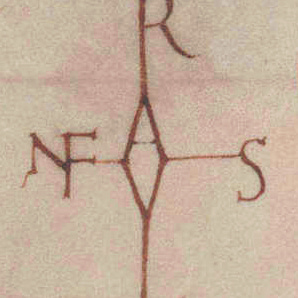
When Arnulf held a kingdom-wide synod in 895, at the royal center of Tribur, there are two Greek words placed in the canons (ПРΑΚΤΙΚΗ and ΘΕΩΡΤΙΚΗ).8 This may have been a way of signaling a quasi-imperial status for Arnulf, and his role within the synod may have recalled Constantine at the Council of Nicaea in 325. I think the Arnulf-Constantine connection was deeper as well, because Constantine was reputedly an illegitimate child like Arnulf,9 and when he conquered Rome in 896 he traveled over the Milvian Bridge into the city.10
The Byzantines, The Bulgarians, and Arnulf
Yet the Byzantines had their own motives: they were embroiled in a conflict with the Bulgarians. The Bavarian author of the continuation of the Annales Fuldenses reports:
The Greeks made peace that same year with the Avars, who are called Hungarians…the Bulgars took this very badly and led a hostile expedition against them and laid waste all their lands as far as the gates of Constantinople. In order to avenge this the Greeks cunningly sent their ships to the Avars and transported them beyond the Danube to the kingdom of the Bulgarians.11
Later, the annalist reports that “the Emperor of the Greeks Leo sent a certain bishop named Lazarus to Caesar Augustus with gifts” where he was received at Regensburg.12 Presumably Lazarus’ visit had something to do with the Bulgarian conflict. In the 880s Arnulf had his own Bulgarian connections, he paid them to attack the Moravians, so perhaps the Byzantines hoped he could assist them in quelling the conflict. To do so they may have brought Arnulf a purple cloak, an event that was later distorted by a St. Emmeram (a monastery in Regensburg) author into a fictional story about Arnulf translating relics from Paris.13 The conflict seemingly worried Arnulf because it had the potential to destabilize the southeastern frontier. Already facing a hostile polity in the Moravians, Arnulf wasn’t too interested in more problems.
This brief account by the Bavarian annalist also suggests that there was pretty good information circulating at the East Frankish court. The detail about the ships being brought to the Danube is seemingly corroborated in two Byzantine sources: the tenth-century continuation of Theophanes and Leo VI’s Taktika.14 I think its pretty likely that the source of this information is either the Byzantine envoy himself, or more general connections between East Francia and the frontier. Another sign of diplomacy is perhaps found in a dual Latin-Greek copy of some Psalms now at St. Gall produced in the late-ninth or early-tenth century.15

That we only have these four recorded embassies in the 870s and 890s doesn’t mean there was not continuing contact between Byzantium and the East Frankish court, but it does seem to indicate that it was at these moments of heightened “imperial” rhetoric at Louis the German and Arnulf’s courts that these embassies took on a greater symbolic significance. Yet it also shows that the distance between Regensburg and Constantinople was not as vast as we might think, and the intervening regions pulled both East Francia and Byzantium into ongoing negotiations. There is certainly more to be said about the connections between the Carolingians and the Byzantines, but I think I will end my ramblings here (for now). I hope you enjoyed this insight into the Carolingians!
Thank you for reading!
If you liked this piece, let us know your thoughts in the comments below!
Dalmatia is now seen as shaped more by Carolingian than Byzantine influence, D. Dzino, “From Byzantium to the West: “Croats and Carolingians” as a Paradigm-Change in the Research of Early Medieval Dalmatia,” in Dzion et al. (eds), Migration, Integration, and Connectivity, pp. 15-31. See also F. Daim, “Byzantine Belts and Avar Birds: Diplomacy, Trade and Cultural Transfer in the Eighth Century,” in W. Pohl et al. (eds), The Transformation of Frontiers, pp. 143-188.
There has been tons of debate about this, but Laury Sarti argues that the Byzantines did not see it as a usurpation. See L. Sarti, Orbis Romanus: Byzantium and the Legacy of Rome in the Carolingian World, pp. 13-39.
I won’t go into this fully, but you can read it in M. McCormick, Origins of the European Economy for a lot of info about embassies and trade with the eastern Mediterranean.
On this wider context with the Arabic world see S. Ottewill-Soulsby, The Emperor and the Elephant.
See AF, s.a. 872, p. 75 and Ekkehard IV, Casus sancti Galli, MGH SS rer. Germ. 84, c. 10, pp. 144-146. On the origin of the relic and Charles’ use see MacLean, Kingship, pp. 156-158.2393
For instance in Gregory of Tours, Historia, eds. Krusch and Levison, MGH Scriptores rerum Merovingicarum 1, no. 1, I.36, p. 27. On the development of the legend in the fourth century see E.D. Hunt, Holy Land Pilgrimage in the Later Roman Empire AD 312–460 (Oxford University Press, 1984), pp. 38-44. Eusebius does not mention the discovery of the cross at all: H.A. Drake, “Eusebius on the True Cross,” Journal of Ecclesiastical History 36, no. 1 (1985); Rufinus, Ecclesiasticae Historiae, ed. Theodor Mommsen, Eusebius Werke_,_ vol. 2, part 2 (J.C. Hinrichs’sche Buchhandlung, 1908), X.7-8, pp. 969-971 adds an account of the finding of the cross in his continuation of Eusebius. Regino, Chronicon, s.a. 364-369 (408-423), p. 17 indicates the varying traditions around the finding of the True Cross. See also Ewig, “Das Bild Constantins,” pp. 21-22. Trier seems to have had a medieval tradition celebrating Helena as a saint, see Ewig, “Das Bild Constantins,” p. 19. If you really want to know more about this, go read pp. 279-280 in my dissertation.
See A. Gillett, Envoys and Political Communication int he Late Antique West, 411-533, pp. 1-35. For the early Middle Ages see R. McKitterick, “Political Ideology in Carolingian Historiography,” in Hen and Innes (eds), The Uses of the Past, pp. 162-174 and P.S. Barnwell, “War and Peace: Historiography and Seventh-Century Embassies,” Early Medieval Europe 6, no. 2 (1997): 138-139.
It is possible that they are drawing on the works of John Cassian in his Conferences or Boethius’ Consolatio. The passage in Boethius that describes the garment of philosophy, using Greek letters, is glossed with these exact words in a late ninth-century St. Gall manuscript now in Naples: Naples, Biblioteca Nazionale, Ms. IV.G.68, fol. 5v, accessible here: https://digital.library.ucla.edu/catalog/ark:/21198/zz00294sdx.
This is noted in Jerome’s translation of Eusebius, later repeated in Bede. Regino also notes it.

AF (B), s.a. 896, p. 130, trans. T. Reuter, The Annals of Fulda, p. 135.
AF (B), s.a. 896, p. 130: Leo vero imperator Grecorum Lazarum quendam vocatum episcopum ad cesarem augustum cum muneribus transmisit.
That is, a story with a very tenuous relation to the truth, see R. Hiestand, “Arnulf von Kärnten, des Basileus Leon VI., der hl. Dionysius und St. Emmeram in Regensburg,” Verhandlungen des Historischen Vereins für Oberpfalz und Regensburg 133 (1993).
I. Bekker (ed.), Theophanes Continuatus, p. 853 and G. Dennis (ed. and trans.), The Taktika, c. 18.40, pp. 452-453.
St. Gall, Stiftsbibliothek Cod. Sang. 17: https://www.e-codices.unifr.ch/en/csg/0017//133.
 | A guest post by
|